

At Crea360 we believe a good plan can change everything. That is why we design Integrated Territorial Strategies (ITS) that balance economic growth with sustainability and social inclusion. With a practical and creative approach, we turn ideas into action plans that prepare cities for the future.
ITSs are urban planning strategies that aim to promote sustainability, social inclusion and innovation in cities. They are comprehensive, long-term city projects.
They are funded by:
European Regional Development Fund (ERDF)
European Social Fund (ESF)
National and regional funds.
First call of the 2021-2027 ERDF period: first half of 2024.
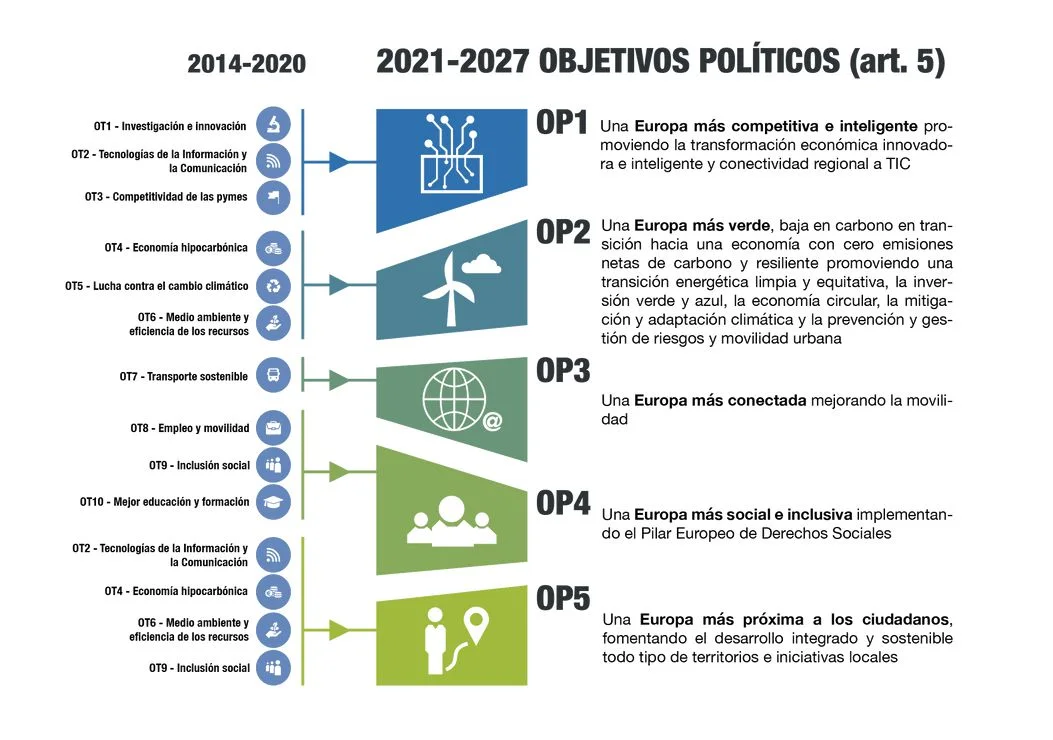
- A more competitive and smarter Europe , promoting innovative and smart economic transformation and regional ICT connectivity
- Research and innovation
- Information and communication technologies
- SME competitiveness
- A A greener Europe, low-carbon and resilient, moving towards a net-zero economy by promoting a clean and fair energy transition, green and blue investment, the circular economy, climate change mitigation and adaptation, risk prevention and management, and urban mobility.
- Low-carbon economy
- Tackling climate change
- Environment and resource efficiency
- A A more connected Europe , improving mobility
- Sustainable transport
- A A more social and inclusive Europe , implementing the European Pillar of Social Rights.
- Employment and mobility
- Social inclusion
- Better education and training
- A A Europe closer to citizens, fostering the integrated and sustainable development of all types of territories and local initiatives
- Information and communication technology
- Low-carbon economy
- Environment and resource efficiency
- Social inclusion
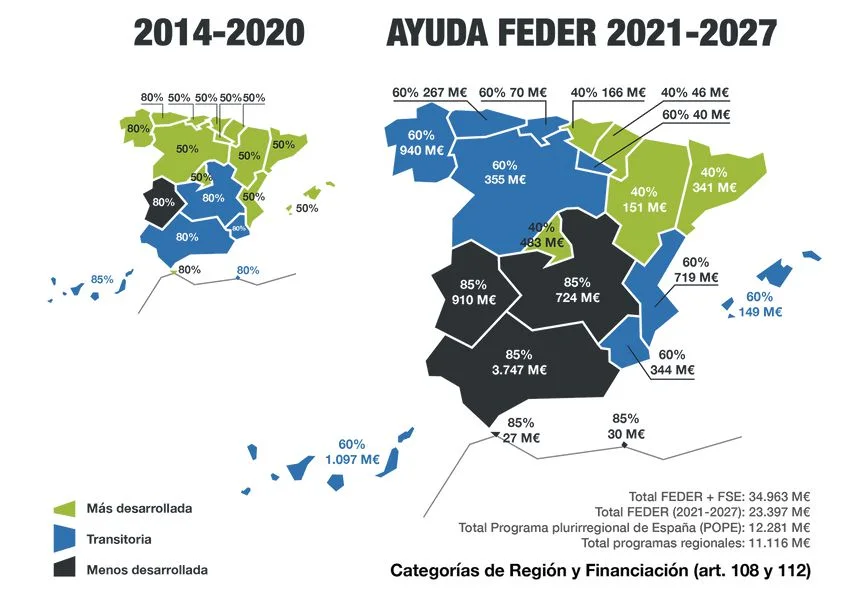
Total funding under Spain’s Multi-regional Programme (POPE) amounts to €12.281 billion. Of this, €1.767 billion is allocated to RSO5.1: promoting integrated and inclusive social, economic and environmental development, culture, natural heritage, sustainable tourism and security in urban areas.
This specific objective 5.1 will be implemented through integrated territorial development strategies.
Territorial allocation of funding
Three urban development models:
- Large cities: more than 75,000 inhabitants (20-30% of the total POPE budget)
- Medium-sized cities: 20,000 to 75,000 inhabitants (40-60% of POPE)
- Functional urban areas: at least 20,000 inhabitants, with a main town of at least 10,000 (5-15% of POPE)
Possible measures under an ITS: Promoting energy efficiency and renewable energy, refurbishing public buildings, conserving and promoting the urban environment for tourism and enhancing historic and cultural heritage, improving the natural environment, sustainable mobility, tackling pollution and climate change, connectivity (especially in smaller urban areas), job creation, self-employment and entrepreneurship, supporting sustainable and local retail, social integration and inclusion (especially of the most vulnerable groups), expanding the public social housing stock, improving accessibility, improving local public services, and promoting open government and public participation.
